Showing posts with label Dave Ramsey Baby Step 1. Show all posts

Tuesday, July 15, 2008

The Total Money Failure

The question has been asked, how is my total money makeover progressing? Well, it is not. This is why I emailed the Dave Ramsey Radio Show and exactly why I should call the show and speak to Dave.

As mentioned in many of my previous posts, Step 1 of the Total Money Makeover involves; a) be current with all of your creditors, b) write a budget, and c) save the $1000 mini emergency fund as fast as possible. So where am I? Struggling with “a”. I could easily pay my creditors and be current if only they would quit sending a new bill each month! Yes, I know this will not happen.

In Dave’s book, The Total Money Makeover, he discusses that it takes gazelle intensity to be successful in the plan. I have seen gazelle intensity in reading some of my reader’s blogs. I have read about treadmills and other unused objects being sold.

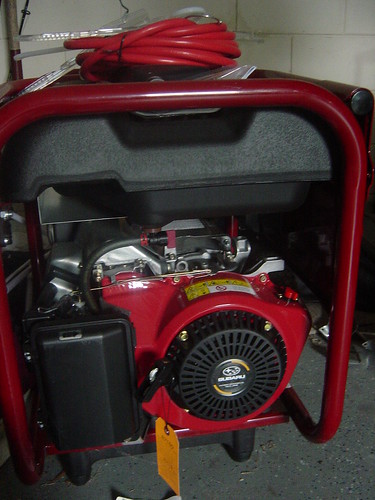
I think everyday about how I can bring in more money. What do I have to sell? DJ and I are not possessions-rich. We do not have expensive toys, recreational vehicles, exercise equipment, excess furniture and both of our vehicles are low value (per Kelley Blue Book). I can only think of one item that DJ and I own that has any value and is not in use, a generator.

Photo by me

On another’s blog, I recently commented that even while working your total money makeover, that sometimes it is ok to spend a little more money on something if it brings you peace of mind. This generator is an object that gives me peace of mind. We live in hurricane central and since we purchased the generator we have not been threatened by a hurricane. It is just our luck that if we sold the generator, we would find ourselves in a hurricane and without power for days or even weeks. If it was just DJ and I, this would not so much be a problem, but now we are a family. We have a child to think about, so I will not be selling our generator.

I know that it will be ok. I will figure something out and begin progressing through the steps. I have been looking into other sources of income and ways to cut back on spending. It will all work out, somehow.

Thursday, June 26, 2008

The Total Money Makeover

I received and finished reading Dave Ramsey’s The Total Money Makeover. I thought that it was a great read, well worth my time, and I would recommend anyone who is in debt to read it. I found it very motivational, and at the end of the book I feel that it is really possible to be debt free.

Photo by Me

The first few chapters focus on debt denial, spending behavior, money and debt beliefs/myths, ignorance, and the false need for approval from others. At the end of chapter 5, you have been shown that by being in debt, you are a slave to that debt and that being an average (in-debt) American means that you are broke. It’s true. I am broke and a slave to my debt. I am forced to continue to work because I need the money to pay my debt commitments. My money is currently “promised” to others for as long as 30 years, if not longer. I will NOT live a slave to my debt, I WILL be debt free.

Chapter 6 starts on the details of the plan, Baby Step 1. There are two things that should be completed before starting on the first baby step – create a budget (not just an initial, but each month) and be current with all of your creditors. I have done neither of these things; but they are both goals that I knew I needed to do before starting on my emergency fund. I knew this before I read the book, and I am glad to read that Dave agrees.

Dave also addresses the question about saving a small emergency fund before paying debt. He points out that most of America uses credit cards to catch all of life’s “emergencies” including anticipated things like Christmas, which is not an emergency but is often treated as one. However, the cycle of dependence on credit cards has to be broken and a well-planned budget for anticipated things and an emergency fund for true emergencies can end the credit card dependency cycle. He continues to say that he use to teach/counsel people to first start on the debt snowball, but he found that an emergency would cause people to stop their Total Money Makeover completely because they felt guilty that they had to stop debt-reducing to survive. To quote the book, “If you use debt after swearing off it, you lose the momentum to keep going. It is like eating seven pounds of ice cream on Friday after losing two pounds that week. You feel sick, like a failure.” So that is why we have an emergency fund; it is a psychological motivator – the key to success with this plan. No more borrowing, break the debt cycle!

After you have a budget and you are current with all of your creditors; it is time to save that emergency fund. You may have to squeeze your budget, work extra hours, sell something, whatever degree of intensity it takes to complete this step quickly, less than a month if possible. No one said it would be easy. The sooner you have completed this step, the sooner you can focus on the debt snowball.

I could go on and review the rest of the book for you, but since I’m still on Baby Step 1, I’m not going to do that. If you are starting this plan too, I highly recommend this book. Dave also has authored other books that may be of interest. Keep in mind that you may not need to purchase the book(s), as your public library may have them available like mine does.

In closing, I challenge you to take this quest too. Don’t just “walk” beside me on my path. Take your own path. You don’t have to follow Dave’s plan, there are other similar plans out there, such as John Cummuta’s “Debt to Wealth”. Regardless of what I choose to do, I suggest you conduct your own research and do what is best for your needs, even combine the best of multiple plans if that is what works best for you. The more you read on the subject, the more knowledgeable and better prepared you will become to conquer your own debt. The time is now! Refuse to be a slave to your debt!

Wednesday, June 18, 2008

Quest to be Debt Free – Step 1 Question Pondering

Since my last post, Quest to be Debt Free - Step 1 of the Plan, I have been asked questions regarding the financial soundness of saving money while owing creditors money. So, in this post I plan to address that question. Before proceeding any further, I want to say that I have requested The Total Money Makeover: A Proven Plan for Financial Fitness By Dave Ramsey from my public library and therefore may be able to answer any questions (not only yours, but my own) better as I learn more. Until then, I will do the best I can based on my limited understanding of the plan.

Shortly after I posted my last blog, I received an email from someone close to me (her name is withheld for her privacy) who is also on a financial freedom program. Her plan is different in that you do not save any money until your debt is first paid in full. There may also be other differences, but this is the only difference that has come up at this time. She says:

“…It is different b/c it tells you not to put money in savings if you own a home. Your home equity is your rainy day plan. Reason: you cannot service debt and grow wealth… "All your money is going to interest: house payment interest, car payment interest, credit card interest, student loan interest." This is YOUR wealth going into others' pockets, just how they want it! Americans are spending tomorrow's money today, just how they want it. The banks and credit cards want you to commit your FUTURE earnings to them, that is how they stay in business. Money you haven't even earned yet, is committed to others for years and years and years to come! . . . money in savings earns 2% or so? Your credit cards are over 18% right? Your loans are over 6% right? You cannot service debt and grow wealth. Every penny goes on debt, once debt is eliminated you can grow wealth…”
I think this comment is a great motivator for starting any financial freedom plan, whatever it may be. There is no direct question here, but unless I misunderstood, the question is similar to the comment Alicia posted:

“I don't know how it is possible to start an emergency fund when you (WE)owe on credit cards already... how do you NOT pay that off first to avoid more apr charges... as in would it not be smarter to get rid of that debt first???”
Yes, it would be financially smarter to get rid of debt first, or at least you would think so. You may remember that I my last post I said the following, “It is difficult for me to imagine saving $1000 with an already tight budget. Not only do I need to find the money to save, I need to resist the urge to pay a bill with it.” Here is what is said about Step 1 on Dave’s website:

“An emergency fund is for those unexpected events that are not regularly planned for happening in life - you lose your job, there's an unexpected pregnancy, the car's transmission goes out, or, or, or. Something like this WILL happen. Money magazine says that 78% of us will have a major negative event happen in any given 10-year period of time. So get a rainy-day fund, an umbrella.

This beginning emergency fund will keep life’s little Murphies from turning into new debt while you work off the old debt. If a real emergency happens, you can handle it with your emergency fund.”
The idea is, if something does happen you will have the cash to help you through it. How would you handle a minor emergency if you did not have the cash on hand? I would have no choice but to pull out a credit card, and then I would be doing opposite of what I want to do. I would not be paying off my debt, I would be increasing it. Sure I could use my home equity, assuming I have any; however, home equity is not liquid. Home equity is extracted via loans creating more debt.

Numerous financial freedom programs exist because what works for one does not work for all. Dave’s plan is not the most mathematically correct plan out there but it is a great starting point. Depending on your individual financial situation, you may end up paying out more in interest in the long run by following Dave’s plan; however, the end result is the same, you are debt free. In addition, as you progress through the plan, you can always adjust your plan and do what is best for you at the time keeping one rule in mind, “owe no one”. The reason Dave’s plan is successful is because it psychologically motivates you to follow through. I will get into this further when I am set to proceed to step two; but if you can't wait – you can always jump ahead of my blog and research the plan on your own. I have provided a few links throughout my blog history and a query search will provide many more resources.

Wednesday, June 11, 2008

Quest to be Debt Free - Step 1 of the Plan

The first step in my plan to be debt free is probably one of the most difficult. I need to save $1000 for an emergency fund. It is difficult for me to imagine saving $1000 with an already tight budget. Not only do I need to find the money to save, I need to resist the urge to pay a bill with it.

Of course, the reasoning behind saving $1000 for an emergency fund makes perfect sense to me. Currently, in the event of a minor emergency we would have no choice but to pull out a credit card. However, the idea of being debt free means that you owe no one and this cannot happen if credit card use continues.

The first thing I need to do for step 1 is to find the money to save. If you remember, I mentioned that in our current situation we only have about $180 after paying our monthly obligations. This does not allow much for saving money or for step 2 - putting additional money towards our debt. That means that the first thing I need to do is find more money.

In attempt to make this a reality, I am trying to work more hours. I am allowed to work 30 hours a week, but in the past have only worked an average of 10 per week. Somehow, I am managing to work more hours and keep up with housework without depriving my son of my attention. It has been challenging, as I more frequently than not have my son tugging at me, wanting me to pick him up or tapping his sippy cup on my leg trying to tell me it is empty. But I have managed.

I have calculated that if I work 30 hours each week, I will be bringing in about as much take home pay as I was working full time before my son was born. There are two main factors that make this so; 1) I am not paying for medical insurance since my husband has us covered, and 2) since I work from home I do not have commuting costs, which are pretty hefty at the moment. In addition, if I went back to working outside of the home I would now have to pay for child care, a cost that I did not have previously.

It will be a couple of weeks to a month before I will be able to start saving. I think it is important to have all of our bills current first. We have fallen behind on some of our bills since we typically spend more than $180 even though that is all our budget allows. My husband can easily spend $150 in gasoline alone, just to go to work. Within the next couple of weeks, I will also set up a strict budget.

I will see where we are at in a couple of weeks, and then if necessary… start selling things.